NASA’s Newest Space Telescope Recognized at New York Stock Exchange

The New York Stock Exchange welcomed team members from NASA’s SPHEREx (Spectro-Photometer for the History of the Universe, Epoch of Reionization and Ices Explorer) mission to celebrate the launch of the agency’s newest astrophysics observatory to understand the origins and structure of the universe. Credit: Image courtesy of NYSE Group
The SPHEREx astrophysics observatory will help answer big questions about the origins of our universe, of galaxies, and the ingredients for life in our galaxy.
Members of NASA’s recently launched SPHEREx (Spectro-Photometer for the History of the Universe, Epoch of Reionization and Ices Explorer) mission team participated in the New York Stock Exchange’s closing bell ceremony in New York City on April 22.
Michael Thelen, SPHEREx flight system manager at NASA’s Jet Propulsion Laboratory in Southern California, is seen here ringing the closing bell. Additional SPHEREx team members from NASA JPL, which manages the mission, and BAE Systems Inc., Space & Mission Systems, which built the telescope and spacecraft bus for NASA, participated.
The New York Stock Exchange welcomed team members from NASA’s SPHEREx mission. Credit: Image courtesy of NYSE Group
Michael P. Thelen, SPHEREx observatory flight system manager, rings the bell alongside NASA SPHEREx team members at the New York Stock Exchange Tuesday, April 25, 2025. Credit: Image courtesy of NYSE Group
The SPHEREx observatory, which launched March 11 from Vandenberg Space Force Base in California on a SpaceX Falcon 9 rocket, will soon begin mapping the universe like none before it. Using 102 color filters to scan the entire sky quickly, SPHEREx will gather data on hundreds of millions of galaxies that will complement the work of more targeted telescopes, like NASA’s Hubble and James Webb space telescopes. Its surveys will help answer some of the biggest questions in astrophysics: what happened in the first second after the big bang, how galaxies form and evolve, and the origins and abundance of water and other key ingredients for life in our galaxy.
More About SPHEREx
SPHEREx is managed by JPL for NASA’s Astrophysics Division within the Science Mission Directorate in Washington. BAE Systems (formerly Ball Aerospace) built the telescope and the spacecraft bus. The science analysis of the SPHEREx data will be conducted by a team of scientists located at 10 institutions across the U.S. and in South Korea. Data will be processed and archived at IPAC at Caltech, which manages JPL for NASA. The mission principal investigator is based at Caltech with a joint JPL appointment. The SPHEREx dataset will be publicly available.
News Media Contact
Alise Fisher
NASA Headquarters, Washington
202-358-2546
alise.m.fisher@nasa.gov
Calla Cofield
Jet Propulsion Laboratory, Pasadena, Calif.
626-808-2469
calla.e.cofield@jpl.nasa.gov
Recent News
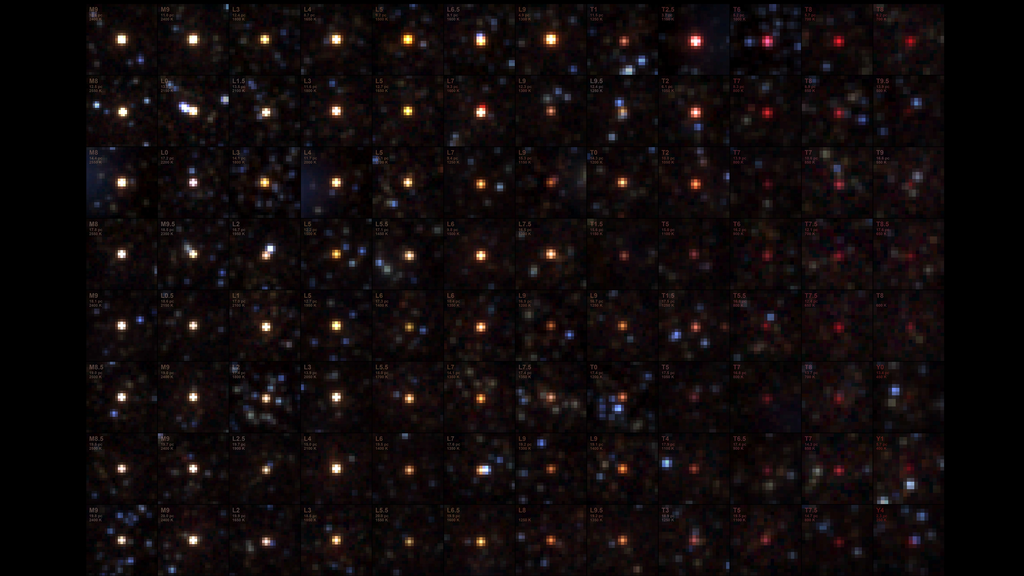
NASA’s SPHEREx Telescope Sees Menagerie of Brown Dwarfs
NASA’s SPHEREx (Spectro-Photometer for the History of the Universe, Epoch of Reionization, and Ices Explorer) space telescope is shedding light on brown dwarfs, celestial objects that blur the line between stars and exoplanets. New findings published in The Astrophysical Journal show that these dark and cloudy worlds have chemically rich atmospheres not unlike the giant planets in our own solar...
Read More
SPHEREx Honored with RNASA Stellar Award
The Rotary National Award for Space Achievement awarded their 2026 Stellar Award to JPL's SPHEREx team for their outstanding contributions to space science and technology.
Read More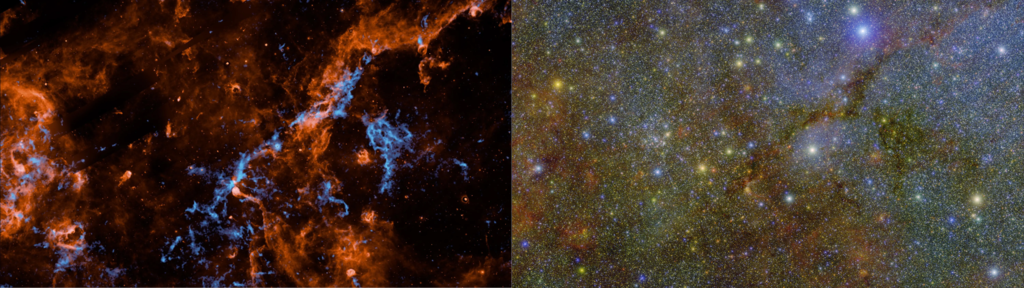
NASA’s SPHEREx (Spectro-Photometer for the History of the Universe, Epoch of Reionization, and Ices Explorer) mission has mapped interstellar ice at an unprecedented scale. Covering regions in our Milky Way galaxy more than 600 light-years across, the ice was found inside giant molecular clouds — vast regions of gas and dust where dense clumps of matter collapse under gravity, giving birth to...
Read More
NASA’s SPHEREx Mission Tracks Brightening of Interstellar Comet
NASA’s SPHEREx mission turned its infrared gaze on interstellar comet 3I/ATLAS in December 2025, adding to the deep pool of information the agency has gathered on what is only the third such object to be discovered passing through our solar system.
Read More
SPHEREx Mission Team Wins ECAD Award
The SPHEREx Mission Team wins the Sylvia A. Earle Award for Exploration Excellence.
Read More