NASA's SPHEREx Observatory Maps Stars and Dust in Cygnus

Observation • April 15th, 2026
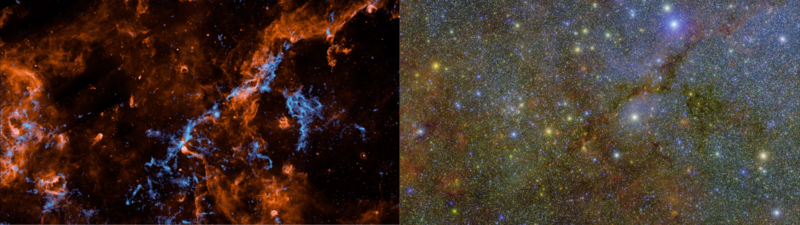
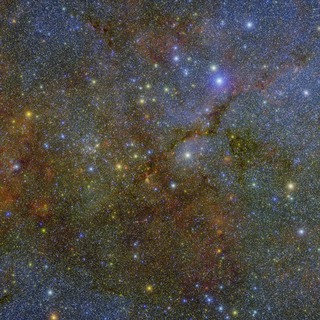
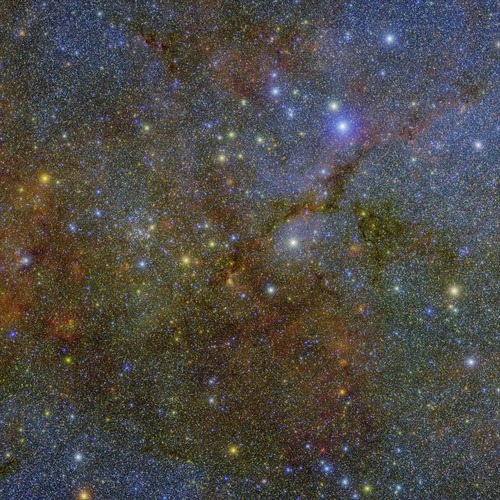
An observation made by NASAs SPHEREx (Spectro-Photometer for the History of the Universe, Epoch of Reionization, and Ices Explorer) shows a dusty infrared starfield in the Cygnus region of the sky.
The three wavelengths chosen (from the 102 mapped out by SPHEREx) highlight the glow of stars deep into the disk or our Milky Way galaxy, in the direction of the constellation Cygnus. The wavelengths of 0.8, 1.63, and 2.6 microns have been assigned to the colors blue, green, and red.
In these colors, the many dust clouds strewn through our galaxy become increasingly transparent at longer wavelengths, causing stars to take on yellow and red tints if they sit behind increasingly dense clouds of dust. The very densest are still opaque in near infrared light and appear as black streaks in this image.
SPHEREx launched March 11, 2025, and has the unique ability to see the sky in 102 colors, each representing a different wavelength of infrared light that offers distinctive information about galaxies, stars, planet-forming regions, and other cosmic features.


About the Object
- Name
- Type
- Nebula > Type > Interstellar Medium
Color Mapping
| Band | Wavelength | Telescope |
| Infrared | 800 nm | SPHEREx |
| Infrared | 1.6 µm | SPHEREx |
| Infrared | 2.6 µm | SPHEREx |
Astrometrics
- Position ()
- RA =20h 30m 32.0s
- Dec = 40° 17' 50.2"
- Field of View
- 5.1 x 5.1 degrees
- Orientation
- North is 53.9° left of vertical