SPHEREx In the News
As we begin getting the SPHEREx team organized following news of our selection and awaiting the official debrief by NASA, a few more news items. We have now been added to the list of missions at JPL. SPHEREx is also mentioned by Sky and Telescope , and we have a wikipedia page too.
Some places where the SPHEREx selection has featured in the news:
CNN | space.com | New Atlas | Engadget | Daily Express | Sky News | Sciences et Avenir (French)
Science | Phys.org | Astroblogs (German) | Popular Mechanics | Rochester First | Global Science (Italian)
Some of the SPHEREx press releases:
JPL | Center for Astrophysics | UC Irvine | Argonne National Laboratory | Arizona State University | Rochester Institute of Technology
Recent News

SPHEREx Honored with RNASA Stellar Award
The Rotary National Award for Space Achievement awarded their 2026 Stellar Award to JPL's SPHEREx team for their outstanding contributions to space science and technology.
Read More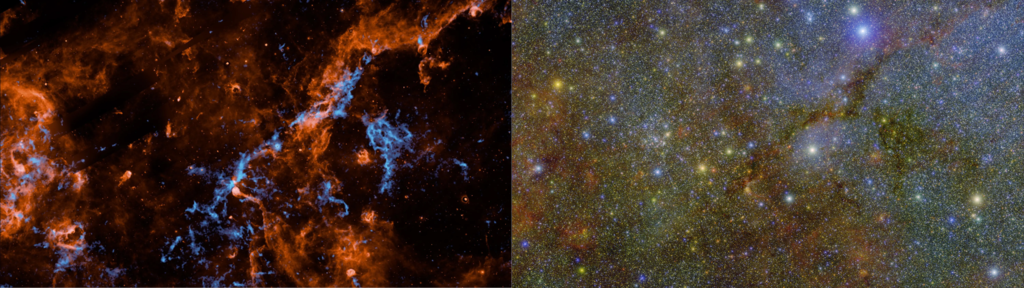
NASA’s SPHEREx (Spectro-Photometer for the History of the Universe, Epoch of Reionization, and Ices Explorer) mission has mapped interstellar ice at an unprecedented scale. Covering regions in our Milky Way galaxy more than 600 light-years across, the ice was found inside giant molecular clouds — vast regions of gas and dust where dense clumps of matter collapse under gravity, giving birth to...
Read More
NASA’s SPHEREx Mission Tracks Brightening of Interstellar Comet
NASA’s SPHEREx mission turned its infrared gaze on interstellar comet 3I/ATLAS in December 2025, adding to the deep pool of information the agency has gathered on what is only the third such object to be discovered passing through our solar system.
Read More
SPHEREx Mission Team Wins ECAD Award
The SPHEREx Mission Team wins the Sylvia A. Earle Award for Exploration Excellence.
Read More
NASA’s SPHEREx Observatory Completes First Cosmic Map Like No Other
Launched in March, NASA’s SPHEREx space telescope has completed its first infrared map of the entire sky in 102 colors. While not visible to the human eye, these 102 infrared wavelengths of light are prevalent in the cosmos, and observing the entire sky this way enables scientists to answer big questions, including how a dramatic event that occurred in the first billionth of a trillionth of a...
Read More