SPHEREx Discovers Extended Carbon Dioxide Coma in Interstellar Object 3I-ATLAS
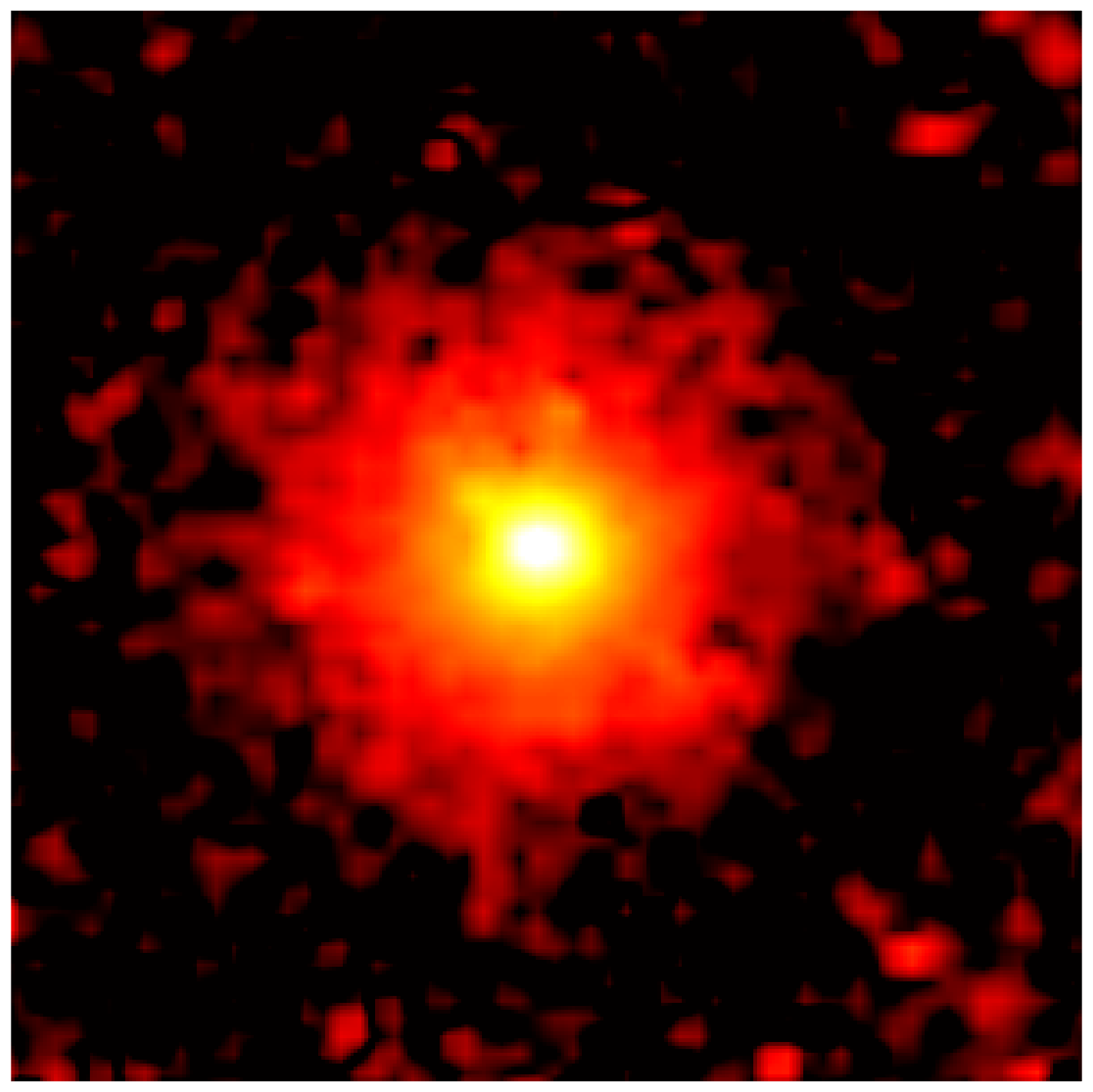
SPHEREx discovered a bright CO2 coma (the extended gaseous atmosphere of a comet) surrounding 3I/ATLAS. It extends out to at least 348,000 km. Credit: NASA/JPL-Caltech.
SPHEREx has made detailed multi-spectral observations of interstellar comet 3I/ATLAS, detecting an abundance of carbon dioxide gas in its coma (the extended gaseous atmosphere of a comet) and water ice in its nucleus. The observations were made between Aug. 8 to Aug. 12, when the object was about 290 million miles (470 million kilometers) from the Sun. This discovery highlights SPHEREx unique capabilities: its spectral resolution allowed us to clearly detect the CO2 emission, while its wide field of view enabled us to map the coma over scales extending 10 arminutes. SPHEREx published a brief Research Notes of the American Astronomical Society, and plans to release a more detailed publication soon.
The third interstellar object discovered to date, 3I/ATLAS originates from another star system and could be billions of years old. It was discovered on July 1 inside the orbit of Jupiter by the NASA-funded ATLAS (Asteroid Terrestrial-impact Last Alert System) survey telescope in Rio Hurtado, Chile. Studying the composition of interstellar objects like 3I/ATLAS can help us better understand the environment from which they were formed. Although further observations are needed to fully understand the interstellar object’s composition — many other NASA missions will be attempting to observe 3I/ATLAS as well — the discovery of an extended CO2 coma and the abundance of ice water shows that 3I/ATLAS may not be so different from the comets that formed around our Sun. Interstellar objects can provide scientists with a better understanding about the chemistry of star systems many light-years away.
Movie illustrating how SPHEREx observation tracked the 3I/ATLAS object. Movie frames are centered on the object and scan in wavelength across the CO2 line. The object moved appreciably throughout the observations. SPHEREx wide spectral mapping capability enables the detection of a very extended CO2 coma. Credit: NASA/JPL-Caltech.
The bottom two panels show SPHEREx 0.75-5.0 μm 2-pixel radius aperture spectrophotometry (left) and solar spectrum corrected reflectance (right) for 3I. Red arrows denote possible significant background contamination due to known background sources. The arrows start at the measured flux+1σ. For the reflectance, the NASA-IRTF/SpeX 0.7-2.5 μm spectrum (green) is overlaid. The two sets of measurements are consistent, and characterized by a slightly rising slope from 0.7-1.0 μm, a flat regime from 1.0-1.5 μm, a shallow absorption at 1.5 and 2.1 μm, and a strong falloff starting at 2.4 μm. The SPHEREx spectrophotometry stays low from 2.5-5.0 μm, with a huge uptick at 4.3 μm due to CO2 gas emission. Also overlaid for comparison is the average “cliff” KBO spectrum of Pinellia-Alonso et al. 2025 (pink). The top row shows, from left to right (1) Stacked 1.0-1.5 μm SPHEREx geometry- and Solar flux-corrected image of 3I. There is no significant extension found in the stacked image beyond a stellar point source in a SPHEREx 6.15” pixel. (2) SPHEREx 3.0/4.26/4.7 μm H2O/CO2/CO gas coma. The object is undetected in H2O and CO. By contrast, a bright CO2 coma that extends out to at least 30-pixel (=348,000 km) was found. Credit: NASA/JPL-Caltech.
Recent News
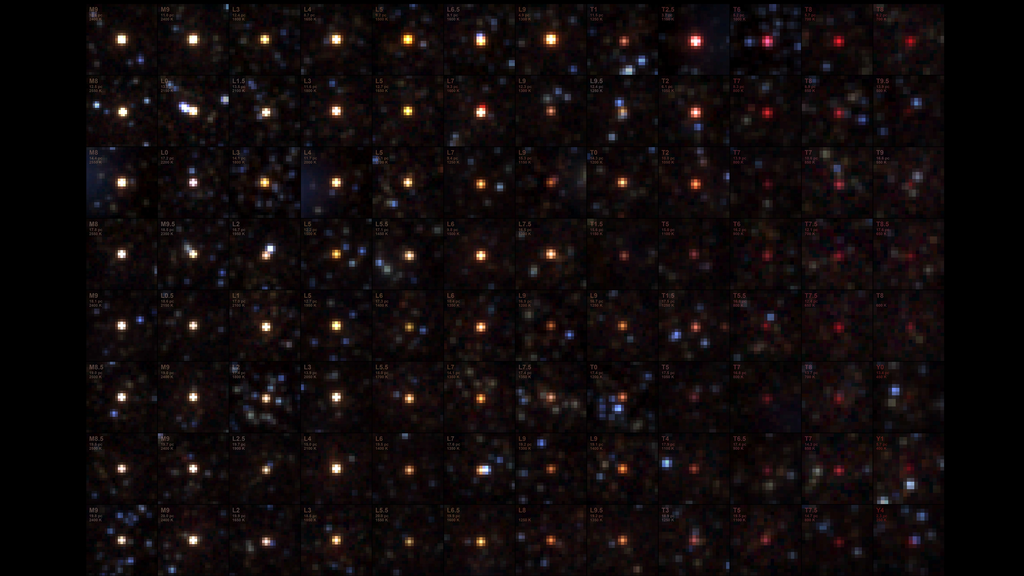
NASA’s SPHEREx Telescope Sees Menagerie of Brown Dwarfs
NASA’s SPHEREx (Spectro-Photometer for the History of the Universe, Epoch of Reionization, and Ices Explorer) space telescope is shedding light on brown dwarfs, celestial objects that blur the line between stars and exoplanets. New findings published in The Astrophysical Journal show that these dark and cloudy worlds have chemically rich atmospheres not unlike the giant planets in our own solar...
Read More
SPHEREx Honored with RNASA Stellar Award
The Rotary National Award for Space Achievement awarded their 2026 Stellar Award to JPL's SPHEREx team for their outstanding contributions to space science and technology.
Read More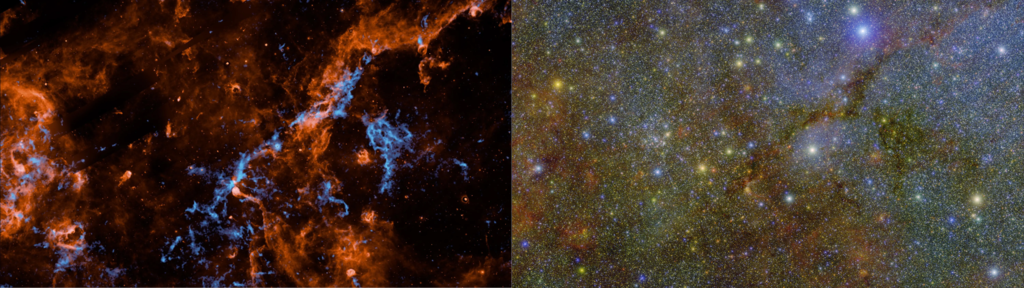
NASA’s SPHEREx (Spectro-Photometer for the History of the Universe, Epoch of Reionization, and Ices Explorer) mission has mapped interstellar ice at an unprecedented scale. Covering regions in our Milky Way galaxy more than 600 light-years across, the ice was found inside giant molecular clouds — vast regions of gas and dust where dense clumps of matter collapse under gravity, giving birth to...
Read More
NASA’s SPHEREx Mission Tracks Brightening of Interstellar Comet
NASA’s SPHEREx mission turned its infrared gaze on interstellar comet 3I/ATLAS in December 2025, adding to the deep pool of information the agency has gathered on what is only the third such object to be discovered passing through our solar system.
Read More
SPHEREx Mission Team Wins ECAD Award
The SPHEREx Mission Team wins the Sylvia A. Earle Award for Exploration Excellence.
Read More